

Table of Contents
Introduction
What’s the darkest story you’ve watched recently? For many fans, the answer is simple: Beyond the Sea Black Mirror. This episode doesn’t just toy with sci-fi ideas; it digs into grief, jealousy, and human fragility in ways that are honestly hard to shake off. Let’s be real, Black Mirror has always been unsettling, but this one hits differently.
Story
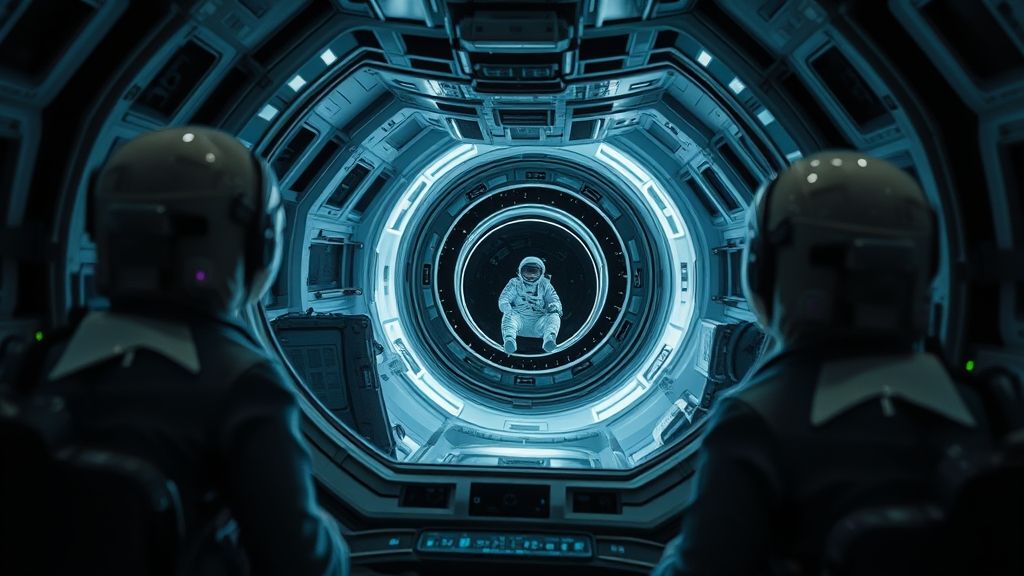
Set in an alternate 1969, Beyond the Sea Black Mirror follows two astronauts, Cliff and David, who are on a long mission in space. But instead of being completely cut off, they use advanced replica bodies back on Earth. This lets them slip into domestic life, hug their families, eat dinner, tuck their kids into bed, and jump back into their cold spacecraft reality.
Sounds like the perfect setup, a way to balance work and family life in the most extreme conditions. But like most Black Mirror stories, it doesn’t stay neat for long. A cult murders David’s family while he’s connected to his replica. He’s forced to watch helplessly. And from that moment, things spiral into envy, blurred boundaries, and eventually, pure devastation.
Honestly, think about it, what would losing everything do to your mind, especially when you’re stuck in space with no way out?
Layers and Themes
So, what makes this story stand out from the rest of the anthology? Well, Beyond the Sea Black Mirror isn’t about flashy gadgets or shocking jump scares. It’s about the slow burn. It’s about what happens when human emotions collide with advanced tech.
Here are a few standout layers:
- Loneliness amplified – Both astronauts are isolated, but David’s grief makes him unravel faster. The replica system becomes more of a curse than a comfort.
- Jealousy and envy – Cliff still has a family. David doesn’t. That imbalance simmers until it boils over.
- The illusion of control – The replicas give the illusion that astronauts can “live” two lives. But let’s be honest, emotions don’t follow clean rules.
This episode feels less like sci-fi and more like an emotional gut punch wrapped in a space drama.
Local Angle / Why It Matters Here
Why does Beyond the Sea Black Mirror seem so different from episodes like San Junipero or USS Callister? To start with, it takes off the bright tech worlds and focuses on something very basic in human nature.
You’d probably not expect it, but the “alternate 1969” location actually contributes to the episode’s scarier mood. There is no internet, no smartphones, no noise or interruptions, just pure feelings, sorrow, and the heavy silence of space. In a sense, it is still (at least) as relevant as today. Our modern gadgets might be a bit ahead of their time, but we are still experiencing loneliness, jealousy, and human weaknesses. The latter have not diminished at all.
Just imagine this: on the one hand, some Black Mirror episodes forecast the future, on the other hand, this one feels it could have happened at any time, either in the past or even right now. This is what really makes it stay.
How It Works (Without the Tech Jargon)
Let’s break down the mechanics in simple steps.
- Astronauts connect their minds to replica bodies on Earth.
- These replicas act just like real humans; they can interact, feel, and live alongside families.
- Time is split between spaceship duty and family life on Earth.
- The system relies on trust. And once that trust cracks, everything falls apart.
That’s it. Not too complicated. And yet, when you look closely, it’s this very simplicity that makes the tragedy sting. Technology is just the background. The real story? It’s people hurting people.

The Ending and Why It Haunts Us
We can’t talk about Beyond the Sea Black Mirror without addressing its ending. After losing his family, David crosses into darker territory. He begins to crave the life Cliff still has. And in one shocking act of betrayal, he murders Cliff’s wife and son while using Cliff’s replica access.
The final scene? Cliff and David were the only ones left inside the spacecraft, which was, in a way, their prison. The silence was all that remained. No loved ones, no future, no way out. Only two shattered men and the infinite emptiness of outer space.
It really is one of those endings that doesn’t give you a feeling of completion. It keeps you uncomfortable, prompting you to rehash your thoughts on the movie and possibly leaving you a bit annoyed. However, this is exactly the reason why it works.
Conclusion
After all, Beyond the Sea Black Mirror episode is neither about space nor about the copies. Rather, it’s about us. It discusses the consequences of denying grief, the destruction of relationships caused by jealousy, and how technology, instead of solving problems, exacerbates them.
So, the next time you recall this episode, don’t only remember the spaceships or the replicas. Remember the episode for its very accurate and quite uncomfortable depiction of the fact that the greatest threat is not technology but the human heart.


